
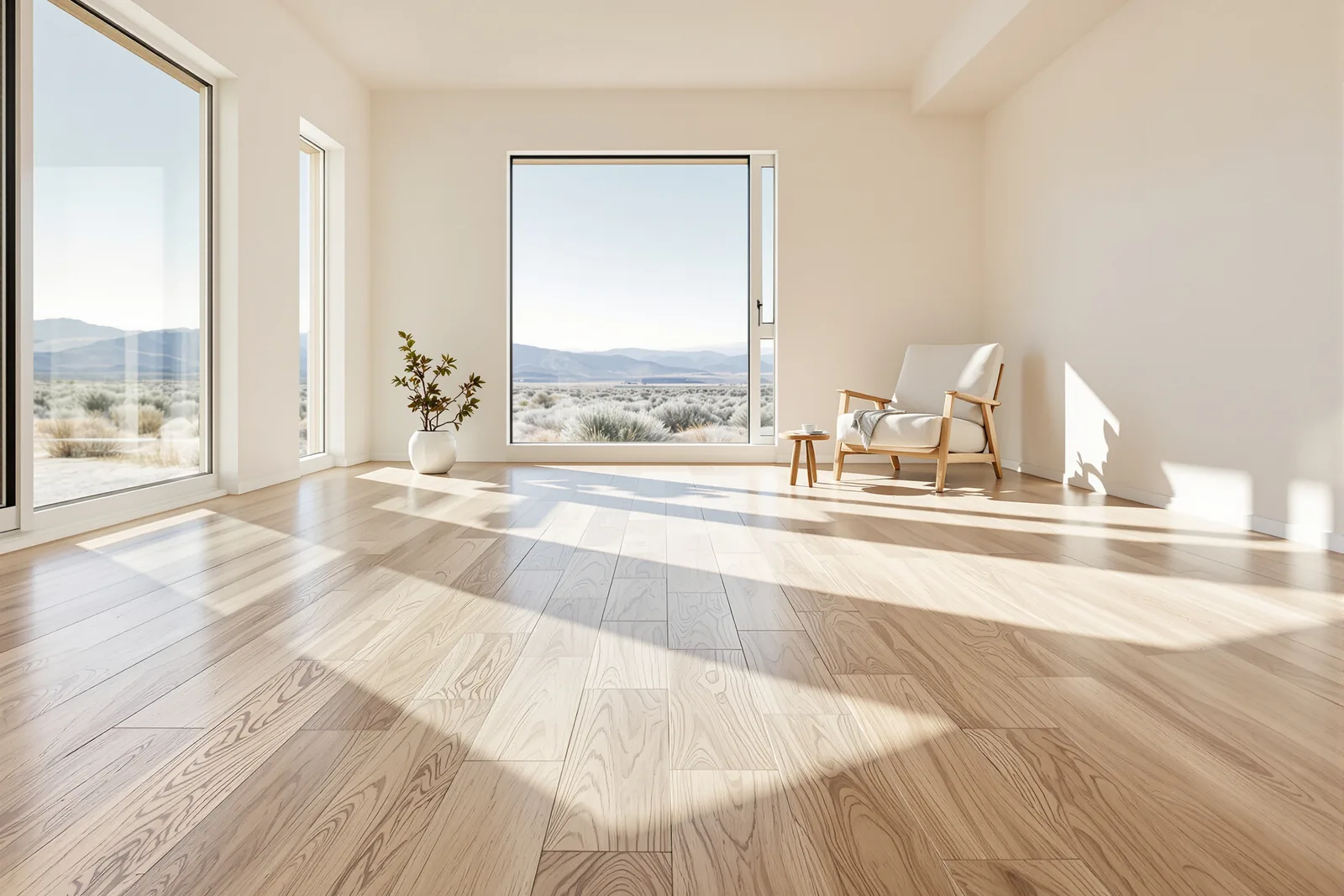
What is the best flooring for Reno's dry climate?
There is no single best floor for Reno, but there is a best floor for each room. Engineered hardwood, rigid-core luxury vinyl plank and porcelain tile all handle the dry air well when they are chosen for the room and acclimated to a house already running at its normal indoor conditions. Solid hardwood works too, in the right width and species, if you accept a little seasonal movement.
The question matters because of where we live. NOAA's climate summary for the Reno airport describes a semi-arid plateau in the lee of the Sierra Nevada, at 4,404 feet, where humidity is very low through the summer and moderately low through the winter. NOAA's 1991–2020 normals put annual precipitation at 7.40 inches. That is a dry house most of the year, and the furnace dries it further for a long stretch of it: NOAA's long-term records put the airport's average first freeze at September 16 and the last at June 1.
So the floors in a Reno or Sparks home are not fighting humidity. They are fighting the absence of it, plus strong sun and a daily temperature swing most places never see.
Why dry air moves wood
Wood is hygroscopic. It takes on moisture from the air and gives it back, and as it does, each board swells or shrinks across its width. In a heated Reno house in January the air is dry, the boards give up moisture, and hairline gaps open between them. In a damp week in spring they close again. This is not a defect; it is what wood does.
The National Wood Flooring Association's guidance is that wood floors live best between 30% and 50% relative humidity and 60°F to 80°F, that flooring should be acclimated only after the HVAC is running and holding those conditions, and that the moisture content of the flooring and a wood subfloor should be within 4% of each other before a board goes down. A floor acclimated to an empty, unheated house is acclimated to the wrong house.
A new build in Damonte Ranch or Kiley Ranch gets its hardwood delivered after the heat is on and the drywall is dry, not on the day the truck is free. In an older Old Southwest or Caughlin Ranch house we meter the existing subfloor first, because a century-old joist bay and a 1990s subfloor tell different stories.
Does Reno's sun fade floors faster?
Yes. The NWFA's technical writers put it plainly: all wood is photosensitive. Light changes the color of every species, lightening some and deepening others, and Reno gives it plenty of chances. NOAA's comparative climatic data counts 251 days with sun a year at the airport, 79% of the possible sunshine. Elevation adds to it. The World Health Organization notes that UV levels rise by about 10% with every 1,000 meters of altitude, and NOAA lists the airport station at 1,344 meters, so the light through a south window here carries more UV than the same window at sea level.
Vinyl is not exempt. Shaw's published warranty for its luxury vinyl lines excludes "changes in color or sheen appearance when exposed to a natural light source", a manufacturer's way of saying the plank in the west window will not match the plank under the sofa in five years. Wood and vinyl both fade; the design question is how gracefully.
Gracefully means planning for it. A rug that never moves leaves a shadow of itself, so we place rugs and furniture on the drawing before the floor goes in and tell you which pieces to shift with the seasons. Lighter, natural-toned floors show the change least. A luxury vinyl plank with a matte, low-sheen finish hides it better than a glossy one.
The daily swing nobody plans for
Reno's temperature travels a long way between dawn and mid-afternoon. NOAA's normals give the airport a diurnal range of 27.6°F, and its climate summary notes that the spread between the daily high and low often exceeds 45 degrees. In summer, highs above 90°F give way to nights in the 50s. A room with a wall of west glass heats hard every afternoon and cools hard every night, and the floor nearest the glass feels all of it.
Every material expands and contracts with temperature, vinyl noticeably so. That is why floating floors need an expansion gap at every wall and a break at wide openings, and why we lean toward glue-down installation in rooms with big glass.
How each material handles a house here
The short version.
- Solid hardwood: the most alive underfoot, and the one that can be sanded back for decades. Narrower boards and quarter-sawn cuts move least; expect hairline gaps in the heating season.
- Engineered hardwood: a real wood wear layer on a cross-ply core, which resists the across-the-grain shrinking that opens gaps. Our first choice for wide planks in this climate and over radiant heat.
- Luxury vinyl plank: does not take on moisture the way wood does, but it moves with temperature and fades in strong light. Rigid-core products stay flattest; check the manufacturer's humidity and temperature range.
- Porcelain tile: unbothered by dry air, sun or a hot afternoon. Cool underfoot in July, cold in January unless there is radiant heat below it.
- Carpet and wool rugs: warm, quiet and forgiving of dry air. Wool holds a little moisture of its own and builds less static than synthetics in a dry winter.
What the climate changes about how we work
Every floor we install here is chosen with three questions in mind: how dry does the house run in winter, which way does the room face, and what is under the existing floor. The first decides species, width and construction. The second decides tone, finish and where the rugs go. The third decides the prep.
Then we let the house set the schedule. Material arrives after the HVAC is holding its normal range, sits in the rooms it will live in, and is metered against the subfloor before the first board is set. Slower than dropping pallets in a garage, and the difference between a floor that gaps every February and one that does not.
Weighing wood against vinyl for a particular room? Our hardwood versus luxury vinyl plank comparison goes deeper. Or tell us about the space and we will bring samples chosen for your light.