
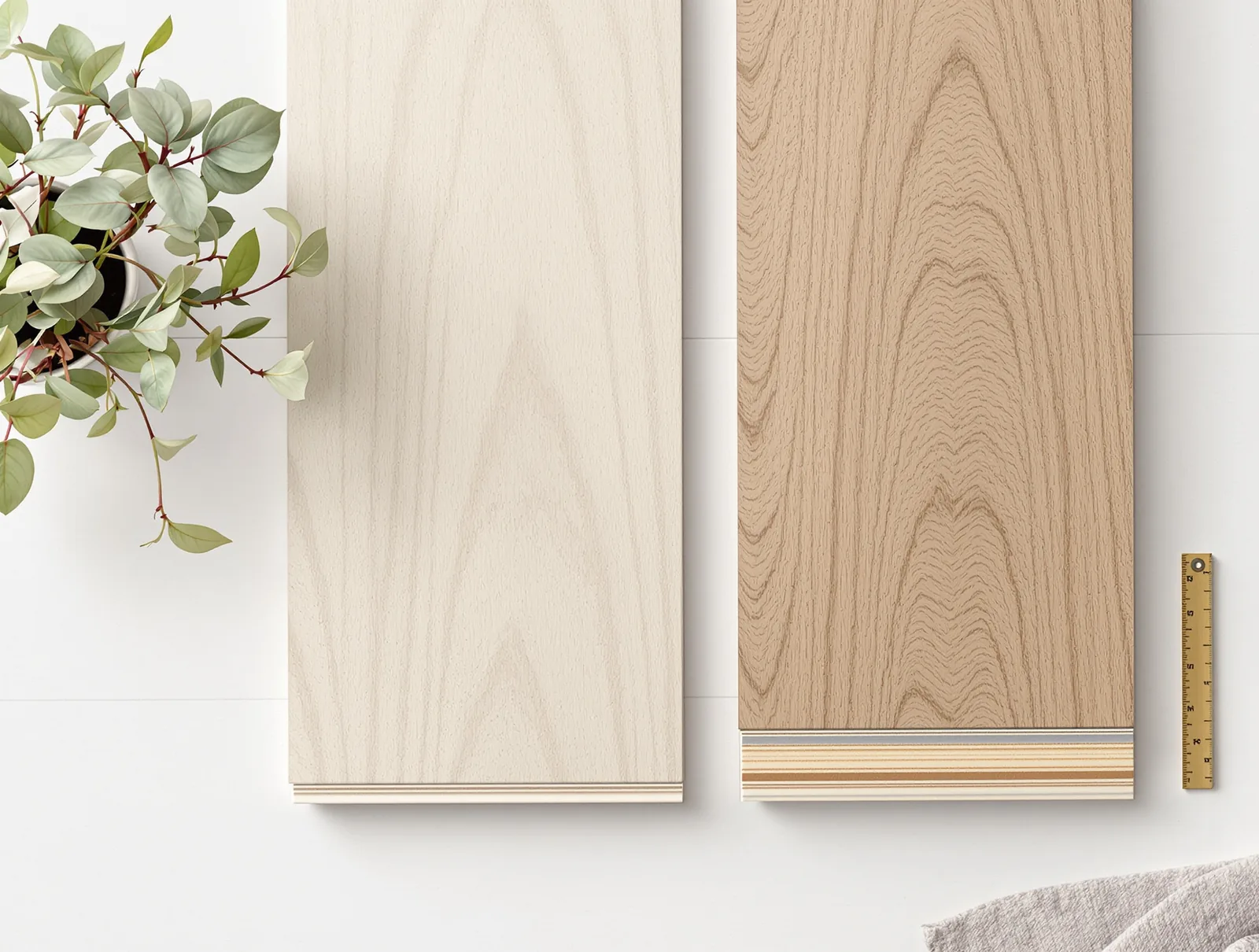
Is luxury vinyl plank better than hardwood?
Neither is better; they are better at different things. Hardwood wins on feel, sound and the ability to be sanded and refinished for decades. Luxury vinyl plank wins in wet and hard-working rooms, and in the rooms you want finished quickly. In most Northern Nevada homes the answer is both, with the line drawn at the doorways where water lives.
The two are not the same kind of thing, which is where most comparisons go wrong. Hardwood is a natural material that moves with the air in your house. Luxury vinyl plank is a manufactured one: a printed image of wood under a clear wear layer, over a core, usually with a pad attached. One is judged on its grain and how it ages. The other is judged on its construction and how honestly it wears.
Below is how each behaves in a Reno or Sparks house, room by room, and what changes the decision.
What you are actually buying
Hardwood comes two ways. Solid boards are one piece of wood, top to bottom, and can be refinished as many times as their thickness allows. Engineered boards put a real wood wear layer over a cross-ply core; the top is still wood, and the core is what keeps a wide plank flat. Both are sold prefinished or finished on site, in species, widths and cuts that change how a room reads more than any other decision you will make.
Luxury vinyl plank is judged from the top down. The wear layer is the clear coat that takes the scratches; it is measured in mils, and thicker is sold for harder use. Under it sits the print layer, which is why two planks from different mills can look like the same oak and age nothing alike. Under that is the core: flexible vinyl, or one of the rigid cores that stay flat over slightly uneven subfloors and tolerate water sitting on the surface. Ask for the spec sheet. The plank is only as good as the numbers on it.
How do they handle Reno's dry winters?
Wood moves with humidity. NOAA's climate summary for the Reno airport describes humidity as very low in summer and moderately low in winter, and the heating season runs long, so the enemy of a wood floor here is dry indoor air. The National Wood Flooring Association's guidance is 30% to 50% relative humidity and 60°F to 80°F for wood floors, acclimation only after the HVAC is running and holding that range, and a moisture difference of no more than 4% between the flooring and a wood subfloor before installation. Meet those and a hardwood floor in Reno behaves. Skip them and it gaps every winter.
Vinyl does not take on moisture the way wood does, but it is not inert. It expands and contracts with temperature, and manufacturers publish their own humidity and temperature limits for the rooms it goes in. Both floors need acclimation and room to move; wood moves with the humidity, vinyl with the temperature.
For the full picture of what dry air, sun and the daily temperature swing do to a floor here, read our guide to flooring for Reno's high-desert climate.
Sun, scratches and the long game
Both fade. The NWFA's technical writers state that all wood is photosensitive, and Shaw's published warranty for its luxury vinyl lines excludes "changes in color or sheen appearance when exposed to a natural light source". The difference is what you can do about it. A faded hardwood floor can be sanded back to fresh wood and refinished. A faded vinyl plank stays faded until it is replaced.
The same logic runs through wear. Dog claws, a dragged chair, a dropped pan: hardwood records all of it, and a good sanding erases the record. Vinyl's wear layer shrugs off most of it, and what gets through cannot be sanded out; with a click-together floor you swap the plank, with a glue-down floor you cut it out. Over twenty years, a hardwood floor is refinished and a vinyl floor is replaced. That is the real long-term comparison, and it is why we ask how long you plan to stay in the house.
Room by room: where each belongs
The honest split, in the order a house is usually walked.
- Living room, dining room, hallways: hardwood. These are the rooms where feel, sound underfoot and the way the grain takes afternoon light are the whole point.
- Bedrooms: hardwood, with a wool rug where the feet land first.
- Kitchen: either. Hardwood if spills get wiped up and it is the same floor as the dining room beside it. Rigid-core vinyl if the household is hard on floors.
- Laundry, mudroom, bathrooms, basement: vinyl or tile, never wood. Standing water finds the joints in a wood floor. Our notes on mudroom and entry floors cover how we plan the wet rooms.
- Stairs: hardwood treads. Vinyl stair pieces exist, but the joints show and the nosings never read as one piece.
- Over radiant heat: engineered hardwood, or a vinyl its manufacturer rates for it. Not solid wide plank.
- Sun-flooded rooms: both fade, so plan the rugs and the furniture before the floor. Wood can be sanded back; vinyl cannot.
What changes the decision, and the price
Water draws the first line, and how long you plan to stay draws the second. After that, the choice usually turns on things you can only judge in the room: how the sample reads in your light at four in the afternoon, whether the doorway to the kitchen can carry a transition, and what the subfloor looks like when the old carpet comes up.
Those same things move the price. Material grade and plank width, the square footage, how much the subfloor needs before it is flat and dry, stairs and transitions, and whether the floor is laid straight or in a pattern. We do not quote from a photo. We measure, check the subfloor and price the whole floor once, with the prep spelled out.
If you want to see both under your own light, tell us about the rooms and we will bring a plank of each.